Holiday grocery shopping math for kids: a real-life budget challenge
By Lisa Fasana · November 2026 · 6 min read
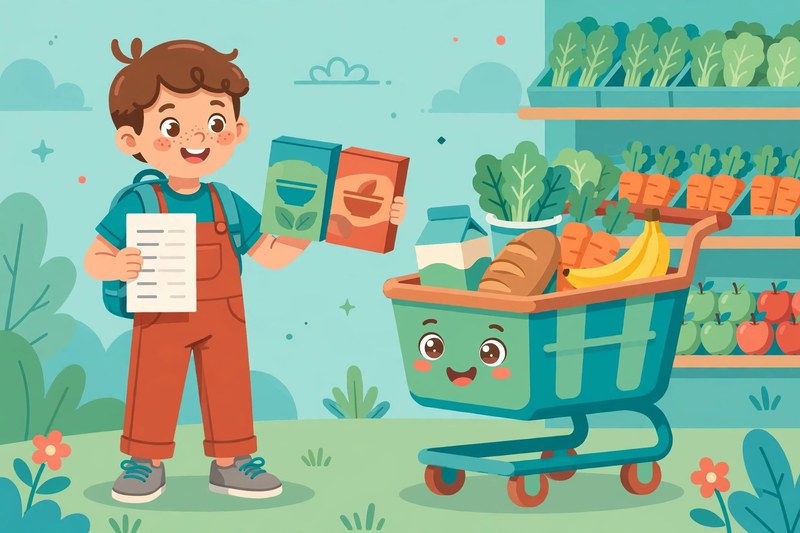
The holiday grocery run is the biggest shopping trip of the year. The list is long, the cart is full, the total is real — and every aisle is a math problem in disguise.
That makes it one of the best math classrooms your kids will ever walk into.
I'm a mom of two with a background in finance and decision support, and I built my whole approach to kids' money math on one idea: kids learn numbers by using them on decisions that feel real. A worksheet can ask what 3 × $1.25 is. A grocery store asks something better: you have $10, the pie costs $6, and you still need whipped cream — can you afford both?
You don't need a lesson plan for this. You need a list, a cart, and a few good questions. Here's how to do it by age — and how to turn it into a full project if your kids get hooked.
Why the holiday shop works so well
- The stakes are real. The food actually gets cooked and eaten. Kids can feel the difference between a pretend budget and a real one.
- The decisions are visible. Two brands of butter, three sizes of turkey, a store-brand swap that saves $2 — trade-offs are sitting right there on the shelf.
- The math is layered. The same trip offers coin-counting for a 7-year-old and unit-price comparisons for a 10-year-old. One cart, every level.
- It repeats. You'll make several trips between now and the New Year. Skills compound fast when kids practice them in the same real setting.
Schools do wonderful work teaching the mechanics of math. Trips like this are where families get to show what the mechanics are for.
Ages 7–9 (grades 2–3): give them a mission inside your trip
Younger kids don't need the whole list. They need a job that's theirs.
1. The $10 mission
Hand your child one small, real part of the shop — baking supplies, movie-night snacks, the ingredients for one side dish — with a hard budget of $10. Their job: choose the items, keep a running total, and come in at or under budget.
The rule that makes it math instead of shopping: they have to be able to tell you the total before you reach the register. Counting, adding prices, and checking "can I still afford this?" is exactly the practice this age needs.
2. Price-tag detective
Pick any item on your list and ask them to find two versions of it. Which one costs less? By how much? Comparing prices and finding the difference is subtraction with a purpose — and kids take it surprisingly seriously when the savings are real.
3. Count the pack
So much holiday food comes in packs: rolls, eggs, apples, cans. Ask: how many are in this pack? If we need 12, how many packs is that? It's early multiplication and division, hiding in the bakery aisle.
Good questions to keep in your pocket:
- "How much have we spent on your mission so far?"
- "If you buy this one, what's left?"
- "Is there a cheaper way to get the same thing?"
Ages 9–11 (grades 4–5): hand over the whole budget
Older kids are ready for the real project: plan and shop an entire piece of the holiday meal on a set budget.
4. The $30 holiday helper challenge
Give them a category — all the sides, or everything for one dessert spread — and a $30 budget. They plan the list at home, estimate the total, then shop it for real, adjusting when actual prices disagree with their estimates. (They will. That's the lesson.)
5. The unit-price showdown
Holiday staples are perfect for unit prices because they come in so many sizes. Which flour is really cheaper — the 5-pound bag at $4.25 or the 10-pound bag at $7.90? Teach them to find the price per ounce on the shelf tag, or work it out: total price ÷ amount. The bigger package usually wins — and "usually" is exactly why we check.
6. Needs, wants & the trade-off talk
A holiday list has non-negotiables and nice-to-haves. If the fancy cheese blows the budget, what comes off the list? Have them sort the list into needs and wants before you go, and make the call themselves when the total runs hot. That's budgeting the way adults actually do it.
7. Receipt detective
Save the receipt. At home, have them check it line by line: does it match what you paid? A fun fact for most families: most states — including California — don't charge sales tax on groceries, so if the receipt shows tax, it usually came from a non-food item like foil pans or flowers. (A handful of states do tax groceries, so check your receipt and see what your state does.) Finding that out from a real receipt beats any textbook explanation.
One more line on the list
If your family gives during the holidays, add one item to your child's mission: something chosen for a food bank or a neighbor, inside the same budget. It's the third job money can do — spend, save, share — learned in the same ten minutes as the arithmetic.
Want the whole thing as a ready-made project?
If your kids light up doing this, both of my grocery packs turn the trip into a complete start-to-finish adventure with a story, a guide for grown-ups, and every answer filled in:
- Cart Captain (grades 2–3) follows a $10 movie-night mission through coins, price tags, comparing prices, and making change.
- Grocery Cart Missions (grades 4–5) is "The Big Shop" — a full week of family shopping on a $30 budget, with unit prices, sales tax, and a receipt-detective finale.
Start with the free sample if you'd like to see the format first — and if your family is more into fall baking than grocery runs, the Harvest Stand pack turns a treat stand into the same kind of real-world math.
However you do it — one $10 mission or the whole $30 challenge — the holiday shop is already on your calendar. It might as well teach something while you're there.
🛒 Run the Family Grocery Shop
Grocery Cart Missions: a 35-page printable story where your child plans the family's weekly shop on a $30 budget — unit prices, better buys, coupons, and checkout math included.
See the Pack — $12